
HINGHAM IN THE AMERICAN REVOLUTION: Not the Gift of Kings
Buy the Book
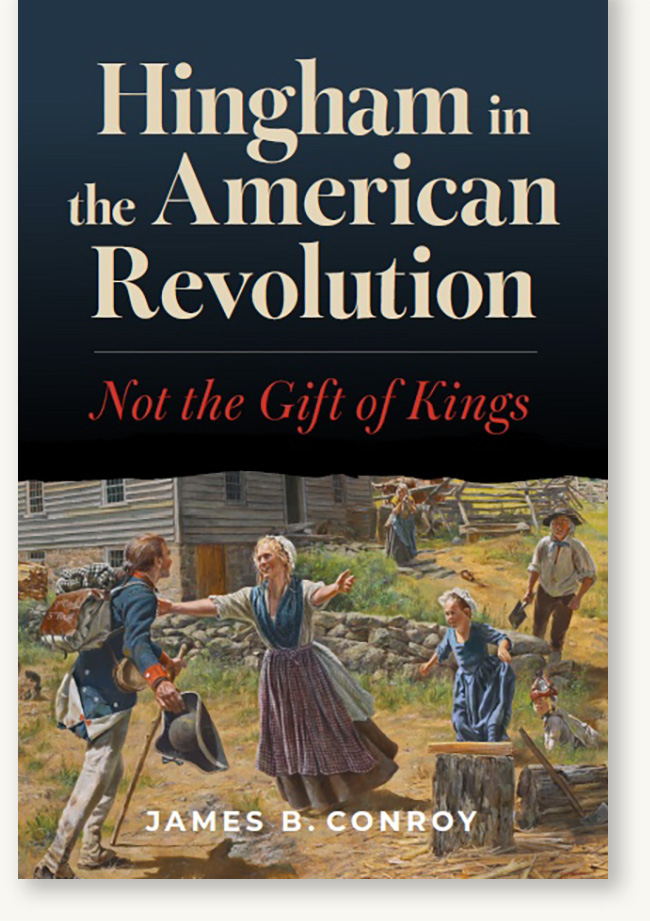
Fueled by vivid letters, candid diaries, and long forgotten first person narratives, Hingham in the American Revolution: Not the Gift of Kings is the character-driven story of an up and coming coastal town unmoored by mass rebellion at a turning point in history. Its cast draws from every level of 18th century New England society from Major General Benjamin Lincoln, Washington's trusted friend and second in command, to a young English girl under house arrest in Hingham, to the townsmen who played key roles in the runup to the Revoluiton, fought in every major battle, and lived to tell the tale. Some convinced their complacent neighbors to resist encroaching tyranny. Others did their best "to keep the past upon its throne." Together they tell a fascinating tale of prerevolutionary politics, cultural change, a familar place at a different time, a tragic civil war, and the birth of the American dream.
HINGHAM IN THE AMERICAN REVOLUTION
Not the Gift of Kings
by James B. Conroy
Pub Date: 6/18/2026
Available for purchase:
Hingham in the American Revolution: Not the Gift of Kings is available for purchase at the Hingham Historical Society, at 34 Main Street, Hingham, Massachusetts, or by order from the Society’s website: hinghamhistorical.org.
The book is also available in Kindle format on Amazon.
Reviews
“Jim Conroy has done a superb job explaining the American Revolution from the bottom up. The experiences of Hingham, Massachusetts, uncannily reflect those of the rest of the colonies as they moved from genuine loyalty to George III in 1760 to outright rebellion against him in 1775-76. The influence of personality on politics is expertly delineated in this deeply researched, well-written, and highly illuminating book. It’s refreshing to know that even 250 years after the Declaration of Independence, important ground-breaking scholarship like this is still being produced.” - Lord Andrew Roberts, author of The Last King of America
* * *
"Before a drop of blood was spilled at Lexington and Concord, the real American Revolution had already taken place. It had taken root in the hearts and minds of tens of thousands of colonists and in hundreds of Massachusetts communities like the coastal farming town of Hingham. The harvest yielded by Hingham’s forests, fields and harbor provided not just subsistence or wealth, but generations of liberty-minded citizens determined to defend what they believed were their rights as Englishmen and, ultimately, as Americans.
Within the story of this single town lies the full spectrum of the Revolutionary experience in New England. Hingham’s leading clergyman, Reverend Ebenezer Gay, embodied the tensions of the age: a minister influenced by Enlightenment ideals, yet rooted in a traditional worldview that still regarded monarchy as the natural political order. Around him lived tradesmen, fishermen, ship and boat builders, merchants, farmers and mariners whose daily lives were shaped by the political and economic crises of the 1760s and 1770s.
The experiences of families such as the Lincolns and Cushings reveal how deeply town life forged the struggle for independence. Some rose to prominence in the Revolutionary cause, while many others lived quieter lives, sustaining the communities that made resistance possible.
In Hingham in the American Revolution: Not the Gift of Kings, author James B. Conroy captures the essence of Revolutionary Massachusetts by showing how the American Revolution was built town by town, family by family, and neighbor by neighbor. From the shores of Hingham Harbor emerges a vivid portrait of the decisions, sacrifices, and convictions that carried one community, and ultimately a nation, into independence."- Jonathan C. Lane, Executive Director, Rev 250
First Pages
PROLOGUE
Christiana Jones was seven years old in April 1775 when Private Allen Simmons fell in with the local militia on a Hingham, Massachusetts green. About to confront the strongest power on earth they were dressed and armed like farmers hunting squirrels. Allen was an eager eighteen. Christiana was seventy-nine when she brought him back to mind in 1847. “I well knew Allen Simmons," she said, "he was my brother, and I well recollect that he was a soldier in the army of the Revolutionary War, or so it was represented to me by himself and others, and I well recollect his absence from home.” She never forgot his return from the siege of Boston, draped in "a part of his military equipments."
In the spring of 1776 Allen had served out his enlistment when a young South Hingham navigator named Walter Hatch called on their father, Reuben Simmons, at their Pleasant Street home. Reuben, the former Sarah Lincoln, and their nine assorted offspring ranging in age and gender from a two-year-old boy to a twenty-three-year-old woman made an ordinary Hingham household. Reuben was a shoemaker. All hands but the youngest will have helped make shoes. Hatch had just signed on as sailing master of a spanking new two masted brigantine, one of the first three ships of the Massachusetts Navy. Soon to be christened Independence, she was small in the shadow of a British man of war but swifter and nimbler in battle. Hatch was about to take her to sea to hunt enemy warships and merchantmen armed with cannon.
Christiana recalled more than seventy years later that Hatch came to "the house of my father" to ask for his consent “to get my brother Allen to go with him.” There was no more dangerous mission than to fight the Royal Navy at sea, but Reuben let his army veteran go at nineteen. Predictably enough, Allen's little brother Kent, all of sixteen, was "desirous to go with him." Kent may not have been old enough to shave, but Christiana seemed unsurprised that "my father gave his consent for him to go also, and they both went together.” We can only guess what their mother thought and how she expressed herself to Reuben, but what could have moved a loving Hingham father to risk his eldest sons, the younger boy still a child, in a villagers' war against an empire? Let us do our best to find out.